Openssl Generate Csr With Key Usage
- Openssl Generate Csr With Key Usage Test
- Openssl Generate Csr With Key Usage Test
- Use Openssl To Generate Key Pair
by Alexey Samoshkin
Jan 20, 2017 Generate a certificate signing request (CSR) for an existing private key $ openssl req -out CSR.csr -key privateKey.key -new. Confirm the contents of CSR. 2 Replies to “OpenSSL Commands & their usage” Pingback: Install Certificate in Windows OS – TPS Application Security Awareness. If you are a new customer, register now for access to product evaluations and purchasing capabilities. Need access to an account? If your company has an existing Red Hat account, your organization administrator can grant you access. OpenSSL usage tips and examples. From ConShell. Jump to: navigation, search. 1 Introduction; 2 Create 2 year self-signed certificate (and key). Generate a new CSR with a new key openssl req -new -nodes -keyout.key -out.csr.
Most common OpenSSL commands and use cases
What you need to do is generate a compliant server certificate request OUTSIDE of ACS then import both the certificate and private key. I have (un)fortunately learned enough openSSL to do this myself but your cert guys should be able to help you generate it. X509v3 Key Usage: critical Digital Signature X509v3 Extended Key Usage: critical Code Signing. Ensure certificate validity. Each one of these certificate generation techniques have very specific use cases and one certificate request should not be used for all three use cases even though it is technically possible. Generate CSR - OpenSSL Introduction. This article provides step-by-step instructions for generating a Certificate Signing Request (CSR) in OpenSSL. Key generator adobe acrobat xi pro mac. This is most commonly required for web servers such as Apache HTTP Server and NGINX. If this is not the solution you are looking for, please search for your solution in the search bar above.
When it comes to security-related tasks, like generating keys, CSRs, certificates, calculating digests, debugging TLS connections and other tasks related to PKI and HTTPS, you’d most likely end up using the OpenSSL tool.
OpenSSL includes tonnes of features covering a broad range of use cases, and it’s difficult to remember its syntax for all of them and quite easy to get lost. man pages are not so helpful here, so often we just Google “openssl how to [use case here]” or look for some kind of “openssl cheatsheet” to recall the usage of a command and see examples.
This post is my personal collection of openssl command snippets and examples, grouped by use case.
Use cases
Here is a list of use cases, that I’ll be covering:
Surely, this is not a complete list, but it covers the most common use cases and includes those I’ve been working with. For example, I skip encryption and decryption, or using openssl for CA management. openssl is like a universe. You never know where it ends. ?
Working with RSA and ECDSA keys
In the commands below, replace [bits] with the key size (For example, 2048, 4096, 8192).
Generate an RSA key:openssl genrsa -out example.key [bits]
Print public key or modulus only:openssl rsa -in example.key -puboutopenssl rsa -in example.key -noout -modulus
Print textual representation of RSA key:openssl rsa -in example.key -text -noout
Generate new RSA key and encrypt with a pass phrase based on AES CBC 256 encryption:openssl genrsa -aes256 -out example.key [bits]
Check your private key. If the key has a pass phrase, you’ll be prompted for it:openssl rsa -check -in example.key
Remove passphrase from the key:openssl rsa -in example.key -out example.key
Encrypt existing private key with a pass phrase:openssl rsa -des3 -in example.key -out example_with_pass.key
Generate ECDSA key. curve is to be replaced with: prime256v1, secp384r1, secp521r1, or any other supported elliptic curve:openssl ecparam -genkey -name [curve] openssl ec -out example.ec.key
Print ECDSA key textual representation:openssl ec -in example.ec.key -text -noout
List available EC curves, that OpenSSL library supports:openssl ecparam -list_curves
Generate DH params with a given length:openssl dhparam -out dhparams.pem [bits]
Create certificate signing requests (CSR)
In the commands below, replace [digest] with the name of the supported hash function: md5, sha1, sha224, sha256, sha384 or sha512, etc. It’s better to avoid weak functions like md5 and sha1, and stick to sha256 and above.
Create a CSR from existing private key.openssl req -new -key example.key -out example.csr -[digest]
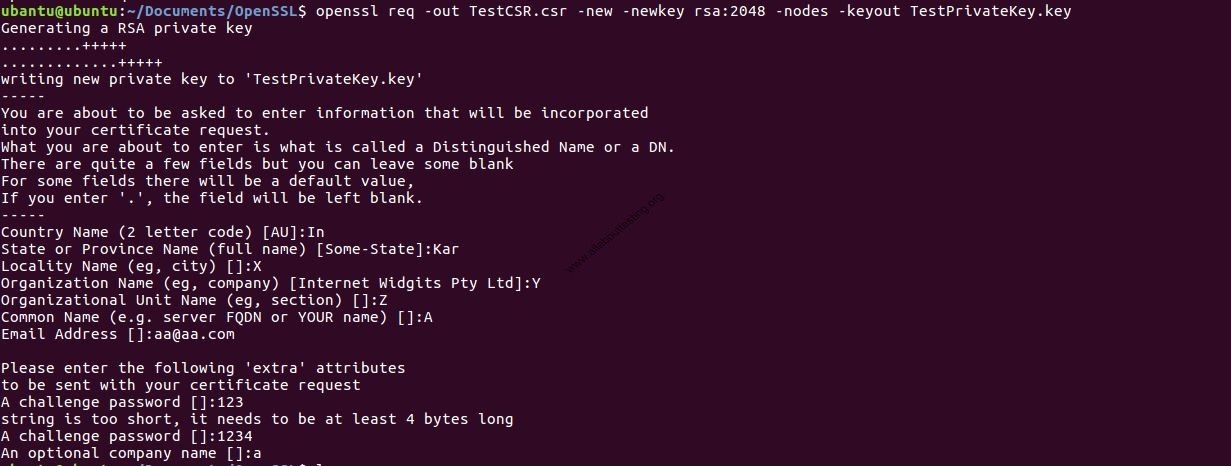
Create a CSR and a private key without a pass phrase in a single command:openssl req -nodes -newkey rsa:[bits] -keyout example.key -out example.csr
Provide CSR subject info on a command line, rather than through interactive prompt.openssl req -nodes -newkey rsa:[bits] -keyout example.key -out example.csr -subj '/C=UA/ST=Kharkov/L=Kharkov/O=Super Secure Company/OU=IT Department/CN=example.com'
Create a CSR from existing certificate and private key:openssl x509 -x509toreq -in cert.pem -out example.csr -signkey example.keyFtp client download for mac.
Generate a CSR for multi-domain SAN certificate by supplying an openssl config file:openssl req -new -key example.key -out example.csr -config req.conf
where req.conf:
Create X.509 certificates
Create self-signed certificate and new private key from scratch:openssl req -nodes -newkey rsa:2048 -keyout example.key -out example.crt -x509 -days 365
Create a self signed certificate using existing CSR and private key:openssl x509 -req -in example.csr -signkey example.key -out example.crt -days 365
Sign child certificate using your own “CA” certificate and it’s private key. If you were a CA company, this shows a very naive example of how you could issue new certificates.openssl x509 -req -in child.csr -days 365 -CA ca.crt -CAkey ca.key -set_serial 01 -out child.crt
Print textual representation of the certificateopenssl x509 -in example.crt -text -noout
Print certificate’s fingerprint as md5, sha1, sha256 digest:openssl x509 -in cert.pem -fingerprint -sha256 -noout
Verify CSRs or certificates
Verify a CSR signature:openssl req -in example.csr -verify
Verify that private key matches a certificate and CSR:openssl rsa -noout -modulus -in example.key openssl sha256openssl x509 -noout -modulus -in example.crt openssl sha256openssl req -noout -modulus -in example.csr openssl sha256
Verify certificate, provided that you have root and any intemediate certificates configured as trusted on your machine:openssl verify example.crt
Verify certificate, when you have intermediate certificate chain. Root certificate is not a part of bundle, and should be configured as a trusted on your machine.openssl verify -untrusted intermediate-ca-chain.pem example.crt
Verify certificate, when you have intermediate certificate chain and root certificate, that is not configured as a trusted one.openssl verify -CAFile root.crt -untrusted intermediate-ca-chain.pem child.crt
Verify that certificate served by a remote server covers given host name. Useful to check your mutlidomain certificate properly covers all the host names.openssl s_client -verify_hostname www.example.com -connect example.com:443
Calculate message digests and base64 encoding
Calculate md5, sha1, sha256, sha384, sha512digests:openssl dgst -[hash_function] <input.filecat input.file openssl [hash_function]
Base64 encoding and decoding:cat /dev/urandom head -c 50 openssl base64 openssl base64 -d
TLS client to connect to a remote server
Connect to a server supporting TLS:openssl s_client -connect example.com:443openssl s_client -host example.com -port 443
Connect to a server and show full certificate chain:openssl s_client -showcerts -host example.com -port 443 </dev/null
Extract the certificate:openssl s_client -connect example.com:443 2>&1 < /dev/null sed -n '/-----BEGIN/,/-----END/p' > certificate.pem
Override SNI (Server Name Indication) extension with another server name. Useful for testing when multiple secure sites are hosted on same IP address:openssl s_client -servername www.example.com -host example.com -port 443
Test TLS connection by forcibly using specific cipher suite, e.g. ECDHE-RSA-AES128-GCM-SHA256. Useful to check if a server can properly talk via different configured cipher suites, not one it prefers.openssl s_client -host example.com -port 443 -cipher ECDHE-RSA-AES128-GCM-SHA256 2>&1 </dev/null
Measure TLS connection and handshake time
Measure SSL connection time without/with session reuse:openssl s_time -connect example.com:443 -newopenssl s_time -connect example.com:443 -reuse
Roughly examine TCP and SSL handshake times using curl:curl -kso /dev/null -w 'tcp:%{time_connect}, ssldone:%{time_appconnect}n' https://example.com
Measure speed of various security algorithms:openssl speed rsa2048openssl speed ecdsap256
Convert between encoding and container formats
Convert certificate between DER and PEM formats:openssl x509 -in example.pem -outform der -out example.deropenssl x509 -in example.der -inform der -out example.pem
Combine several certificates in PKCS7 (P7B) file:openssl crl2pkcs7 -nocrl -certfile child.crt -certfile ca.crt -out example.p7b
Convert from PKCS7 back to PEM. If PKCS7 file has multiple certificates, the PEM file will contain all of the items in it.openssl pkcs7 -in example.p7b -print_certs -out example.crt
Combine a PEM certificate file and a private key to PKCS#12 (.pfx .p12). Also, you can add a chain of certificates to PKCS12 file.openssl pkcs12 -export -out certificate.pfx -inkey privkey.pem -in certificate.pem -certfile ca-chain.pem
Convert a PKCS#12 file (.pfx .p12) containing a private key and certificates back to PEM:openssl pkcs12 -in keystore.pfx -out keystore.pem -nodes
List cipher suites
Openssl Generate Csr With Key Usage Test
List available TLS cipher suites, openssl client is capable of:openssl ciphers -v
Enumerate all individual cipher suites, which are described by a short-hand OpenSSL cipher list string. This is useful when you’re configuring server (like Nginx), and you need to test your ssl_ciphers string.openssl ciphers -v 'EECDH+ECDSA+AESGCM:EECDH+aRSA+SHA256:EECDH:DHE+AESGCM:DHE:!RSA!aNULL:!eNULL:!LOW:!RC4'
Manually check certificate revocation status from OCSP responder
This is a multi-step process:
- Retrieve the certificate from a remote server
- Obtain the intermediate CA certificate chain
- Read OCSP endpoint URI from the certificate
- Request a remote OCSP responder for certificate revocation status
First, retrieve the certificate from a remote server:openssl s_client -connect example.com:443 2>&1 < /dev/null sed -n '/-----BEGIN/,/-----END/p' > cert.pem
You’d also need to obtain intermediate CA certificate chain. Use -showcerts flag to show full certificate chain, and manually save all intermediate certificates to chain.pem file:openssl s_client -showcerts -host example.com -port 443 </dev/null
Read OCSP endpoint URI from the certificate:openssl x509 -in cert.pem -noout -ocsp_uri
Request a remote OCSP responder for certificate revocation status using the URI from the above step (e.g. http://ocsp.stg-int-x1.letsencrypt.org). openssl ocsp -header 'Host' 'ocsp.stg-int-x1.letsencrypt.org' -issuer chain.pem -VAfile chain.pem -cert cert.pem -text -url http://ocsp.stg-int-x1.letsencrypt.org
Resources
I’ve put together a few resources about OpenSSL that you may find useful.
OpenSSL Essentials: Working with SSL Certificates, Private Keys and CSRs DigitalOcean — https://www.digitalocean.com/community/tutorials/openssl-essentials-working-with-ssl-certificates-private-keys-and-csrs
The Most Common OpenSSL Commands — https://www.sslshopper.com/article-most-common-openssl-commands.html
OpenSSL: Working with SSL Certificates, Private Keys and CSRs — https://www.dynacont.net/documentation/linux/openssl/