Mac Os Sierra Generate Ssh Key
After I upgraded MacOS Sierra, my SSH key access to Ubuntu servers broke. I learned that my older ssh-dss (DSA) keys were no longer secure and that I needed to replace them with RSA keys.
- Generate Ssh Key Putty
- Mac Os Sierra Generate Ssh Key Login
- Mac Os Sierra Generate Ssh Key For Git
- Mac Os Sierra Generate Ssh Key Linux
- Mac Os Sierra Generate Ssh Key Mac
Updating server keys is always a bit time consuming. If you want more background on this, check out: Secure Your Instance
Oct 01, 2016 The MacOS Sierra upgrade breaking SSH keys. After I upgraded MacOS Sierra, my SSH key access to Ubuntu servers broke. I learned that my older ssh-dss (DSA) keys were no longer secure and that I needed to replace them with RSA keys. You can choose to either Generate a new key, or Import an existing key. Generate New Key. To generate a new key, tap the + button on the Keys pane of Coda’s settings and choose Generate New Key. Choose a descriptive name for your key, and optionally set a passphrase. Choose your key type, and size. Then tap “Generate” to create your keypair.
Here’s what worked well for me:
Reactivate Password Authentication
However, you can follow the same process to use a private key when using any terminal software on Linux. Note: For information about using Secure Shell (SSH) private keys on Microsoft® Windows® operating systems, see Logging in with an SSH Private Key on Windows and Generate RSA keys with SSH by using PuTTYgen. Jun 24, 2018 Saving SSH keys in macOS Sierra keychain. Contribute to jirsbek/SSH-keys-in-macOS-Sierra-keychain development by creating an account on GitHub. Sep 26, 2019 Manually generating your SSH key in macOS ›. To generate SSH keys in macOS, follow these steps: Enter the following command in the Terminal window. Ssh-keygen -t rsa. This starts the key generation process. When you execute this command, the ssh-keygen utility prompts you to indicate where to store the key.
Firstly, I logged into my Digital Ocean droplets via the virtual host console they offer. With this, I turned back on PasswordAuthentication temporarily on my servers:
Office 2016 professional product key generator. $ sudo nano /etc/ssh/sshd_config
# Change this back temporarily to yes
# Change to no to disable tunnelled clear text passwords
PasswordAuthentication yes
Then, I reset the SSH service:$ sudo service ssh restart
If you can’t access your server in any way, there may be no easy way to regain access without using another device. For example, I use Panic’s Prompt 2 SSH App on my iPad.
Create a New RSA Key
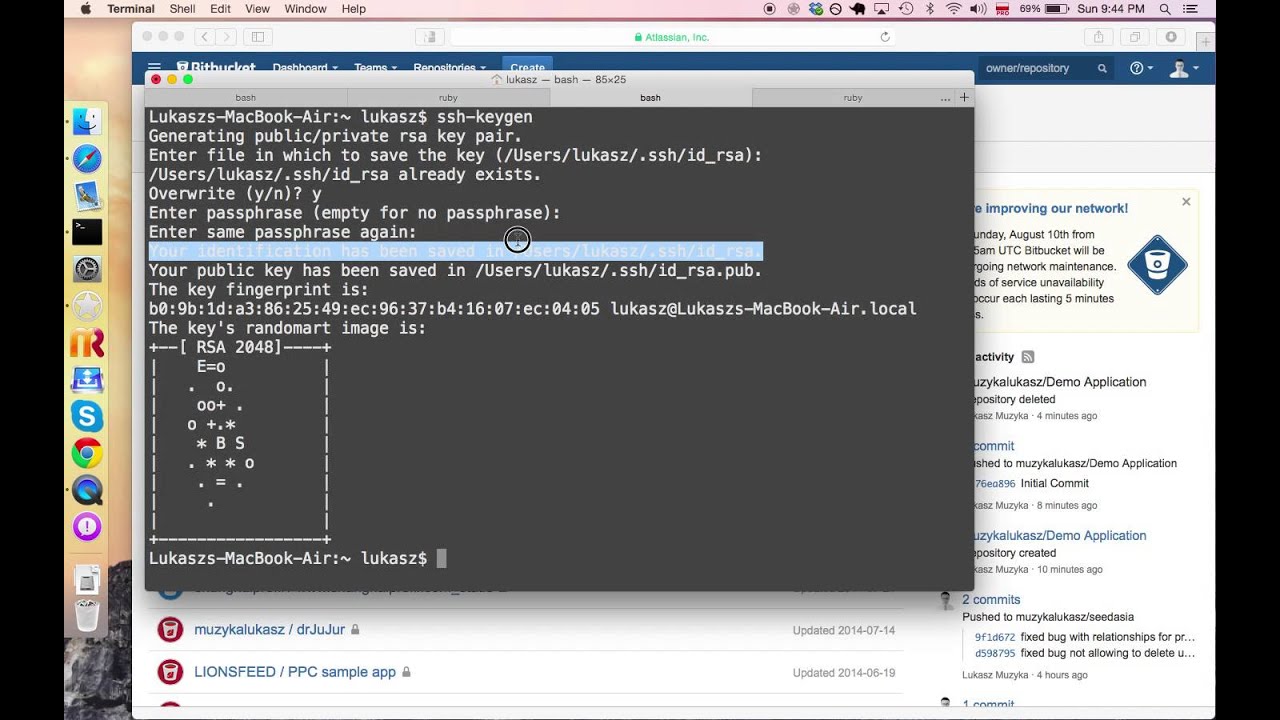
Next, we’ll create the new RSA key on my Mac.$ ssh-keygen -t rsa
Generate Ssh Key Putty
You’ll see something like this:$ ssh-keygen -t rsa
Generating public/private rsa key pair.
Enter file in which to save the key (/Users/Jeff/.ssh/id_rsa): id_newkey
Enter passphrase (empty for no passphrase):
Enter same passphrase again:
Your identification has been saved in id_newkey.
Your public key has been saved in id_newkey.pub.
The key fingerprint is:
SHA256:aUxJKyyyyyyJW9cTqZxxxxxxCErTmI8
The key's randomart image is:
+---[RSA 2048]----+
*B%a .
Fo.+.oo
. o C. o
.=.+o.
o 7 +o o
.o.. .
o . o.
. o= oS o.
. ..
+----[SHA256]-----+
Then, I copied out the public key so I could upload to a sharing service:$ cat ~/.ssh/id_newkey.pub
ssh-rsa AAAAB3NzaC1yxxxxyyyyzzzz123121231jakdljasdasdasdklasjdlakszaC1yxxxxyyyyzzzz123121231jakdljasdasdasdklasjdlakszaC1yxxxxyyyyzzzz123121231jakdljasdasdasdklasjdlakszaC1yxxxxyyyyzzzz123121231jakdljasdasdasdklasjdlakszaC1yxxxxyyyyzzzz123121231jakdljasdasdasdklasjdlaksfTt12MRn Jeff@Skybook-Pro.local
Upload the New Key to Github Gist
Next, I created a new private Gist and pasted the public key into it and saved it.
Visiting the raw page for that gist, I copied the URL for the raw content of the Gist. There may be a more obvious way in the UX but I couldn’t find it.
Sign in to Your Server
Next, I used password authentication to sign in to my server:$ ssh -p 22 superjeff@webstar.lookingatyour.com
Mac Os Sierra Generate Ssh Key Login
And, I performed the following steps to retrieve the public key from Gist and store it on the server. Then, add it to the authorized_keys file:
$ cd ~
$ wget https://gist.githubusercontent.com/newscloud/415axxxxyyyyyzzzz123axxxxyyyyyzzzz123axxxxyyyyyzzzz12392/id_newkey
$ cd .ssh
$ cat ./id_newkey >> authorized_keys
Verify New Key Authentication to to Your Server
Then, I tested it in another terminal window from my Mac:$ ssh -p 22 -i ~/.ssh/id_newkey superjeff@webstar.lookingatyour.com
Everything worked fine!
Turn Off Password Access to Your Server
Mac Os Sierra Generate Ssh Key For Git
Bitcoin private key generator software. Then, I returned to the server and turned off PasswordAuthentication:$ sudo nano /etc/ssh/sshd_config
# Change to no to disable tunnelled clear text passwords
PasswordAuthentication no
Mac Os Sierra Generate Ssh Key Linux
Then, I reset the SSH service:$ sudo service ssh restart
Mac Os Sierra Generate Ssh Key Mac
And that was it, just a few hours lost hunting down and duplicating the proper steps.
It’s odd I didn’t know about this and odd that the Sierra upgrade doesn’t warn you about it as it upgrades OpenSSH behind the scenes.