Generate Public Key From Private Key Openssl
Common OpenSSL Commands with Keys and Certificates
To generate private (d,n) key using openssl you can use the following command: openssl genrsa -out private.pem 1024 To generate public (e,n) key from the private key using openssl you can use the following command: openssl rsa -in private.pem -out public.pem -pubout. I am responsible for maintaining two Debian servers. Every time I have to do anything with security certificates, I Google for tutorials and beat away until it finally works. However, in my search.
Generate RSA private key with certificate in a single command
Generate Certificate Signing Request (CSR) from private key with passphrase
Generate RSA private key (2048 bit)
Generate a Certificate Signing Request (CSR)
Generate RSA private key (2048 bit) and a Certificate Signing Request (CSR) with a single command
Convert private key to PEM format
Generate a self-signed certificate that is valid for a year with sha256 hash
View details of a RSA private key
View details of a CSR
View details of a Certificate
View details of a Certificate in DER format
Convert a DER file (.crt .cer .der) to PEM
Convert a PEM file to DER
Download and install the OpenSSL runtimes. If you are running Windows, grab the Cygwin package. Sony vegas 13 key generator.
OpenSSL can generate several kinds of public/private keypairs.RSA is the most common kind of keypair generation.[1]
Other popular ways of generating RSA public key / private key pairs include PuTTYgen and ssh-keygen.[2][3]
Generate an RSA keypair with a 2048 bit private key[edit]
Execute command: 'openssl genpkey -algorithm RSA -out private_key.pem -pkeyopt rsa_keygen_bits:2048'[4] (previously “openssl genrsa -out private_key.pem 2048”)
Openssl Create Key Pair
e.g.
Make sure to prevent other users from reading your key by executing chmod go-r private_key.pem afterward. Revit 2017 download for mac.
Extracting the public key from an RSA keypair[edit]
Execute command: 'openssl rsa -pubout -in private_key.pem -out public_key.pem'
e.g.
A new file is created, public_key.pem, with the public key.
It is relatively easy to do some cryptographic calculations to calculate the public key from the prime1 and prime2 values in the public key file.However, OpenSSL has already pre-calculated the public key and stored it in the private key file.So this command doesn't actually do any cryptographic calculation -- it merely copies the public key bytes out of the file and writes the Base64 PEM encoded version of those bytes into the output public key file.[5]
Viewing the key elements[edit]
Execute command: 'openssl rsa -text -in private_key.pem'
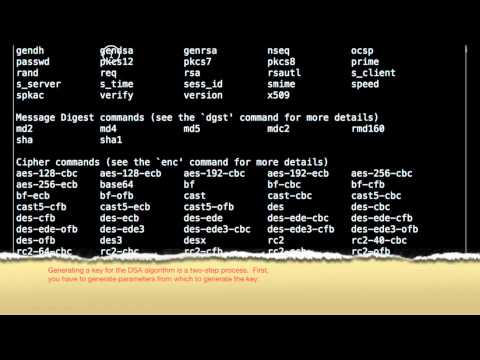
All parts of private_key.pem are printed to the screen. This includes the modulus (also referred to as public key and n), public exponent (also referred to as e and exponent; default value is 0x010001), private exponent, and primes used to create keys (prime1, also called p, and prime2, also called q), a few other variables used to perform RSA operations faster, and the Base64 PEM encoded version of all that data.[6](The Base64 PEM encoded version of all that data is identical to the private_key.pem file).
Password-less login[edit]
Often a person will set up an automated backup process that periodically backs up all the content on one 'working' computer onto some other 'backup' computer.
Because that person wants this process to run every night, even if no human is anywhere near either one of these computers, using a 'password-protected' private key won't work -- that person wants the backup to proceed right away, not wait until some human walks by and types in the password to unlock the private key.Many of these people generate 'a private key with no password'.[7]Some of these people, instead, generate a private key with a password,and then somehow type in that password to 'unlock' the private key every time the server reboots so that automated toolscan make use of the password-protected keys.[8][3]
Further reading[edit]
- ↑Key Generation
- ↑Michael Stahnke.'Pro OpenSSH'.p. 247.
- ↑ ab'SourceForge.net Documentation: SSH Key Overview'
- ↑'genpkey(1) - Linux man page'
- ↑'Public – Private key encryption using OpenSSL'
- ↑'OpenSSL 1024 bit RSA Private Key Breakdown'
- ↑'DreamHost: Personal Backup'.
- ↑Troy Johnson.'Using Rsync and SSH: Keys, Validating, and Automation'.
- Internet_Technologies/SSH describes how to use 'ssh-keygen' and 'ssh-copy-id' on your local machine so you can quickly and securely ssh from your local machine to a remote host.